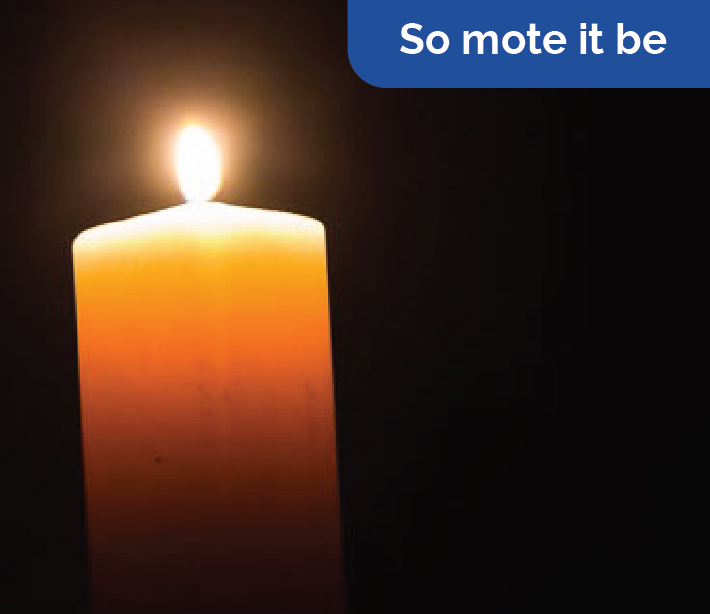
Through December, we will surely see wonderful displays of Christmas decorations, in shop windows, in our streets, gardens and indeed our homes. A myriad of colours striking out against the gloom and cold of our winter weather. It’s wonderful to see such great creativity as we travel through our towns and villages. These twinkling lights on a cold winter’s night reflect the love, hope and joy that Christ’s coming brought to the world- breaking out, shining out into the darkness around us. Though Christmas, and other faiths like Hanukkah, and Diwali are distinct holidays, they share a common theme: light as a symbol of hope, faith, and the triumph of good over evil. Whether it is the birth of Jesus, the miracle of the oil, or the return of Lord Rama, the stories behind these festivals remind us that light has the power to transform our lives, to guide us through dark times, and to illuminate our path toward spiritual renewal and connection with others.
In many ways, the symbolism of light in these festivals transcends religious and cultural boundaries. Light has the power to unite us, reminding us that no matter the faith we follow, the darkness we face, or the struggles we endure, we can always find a source of light, whether in the form of a guiding star, a burning menorah, a flickering diya, or the love and compassion we share with one another.
There is something deeply evocative about light in the darkness. We humans are creature’s who find meaning in light, perhaps because it reveals things to us, gives us direction, and makes the world feel less terrifying. When we are initiated as entered apprentice masons’ part of the ceremony says: Having been kept for a considerable time in a state of darkness, what, in your present situation, is the predominant wish of your heart? The Answer comes from the candidate, “LIGHT!”
However, sometimes it is also in darkness that we are often most profoundly formed-where our sense of longing, our need for purpose, and our desire for love and transformation can emerge with clarity. There is an interplay between light and darkness, and it’s worth considering what this relationship can teach us about the human condition.
For Christians around the world, Christmas is the celebration of the birth of Jesus Christ, whom Christians believe to be the Light of the World. The very idea of light in this context carries deep significance. The Gospel of John speaks of a "true light" that "shines in the darkness, and the darkness has not overcome it" (John 1:5). Here, light is not simply a physical phenomenon-it is a metaphor for hope, for life, for truth itself, which enters the world in the form of a child. This light of Christmas is a quiet one. It is not the blinding brightness of power or might, but the fragile, flickering flame of a child-an infant whose birth signals the possibility of transformation. The story of Jesus' birth is set against the backdrop of a world that is familiar with suffering, fear, and oppression, and yet, into this very world, a small and fragile light breaks in, offering something that cannot be extinguished.
Perhaps this, in itself, is a profound message for everyone; that light does not always come in ways we expect. It is not always grand or spectacular; rather, it often comes in the form of something humble and vulnerable-something that needs to be cared for and nurtured, something that grows slowly and steadily.
This is the paradox of Christmas: Our world is invited to celebrate to rejoice in the coming of light, yet the light that comes is gentle, hidden in plain sight, a quiet radiance.
At their core, Christmas, Hanukkah and Diwali faith festivals emphasise the same message: light shines brightest in the darkest of times. Christmas lights shimmer on snowy nights, Hanukkah candles illuminate homes with warmth and tradition, and Diwali lamps brighten the darkened skies, each offering its own unique reminder that light, in all its forms, is a source of hope, a way forward, and a symbol of the enduring power of faith.
These celebrations, though rooted in distinct cultures and spiritual practices, all share a common theme: light breaking through the darkness. As we explore the significance of these lights, we’re drawn into a cosmic narrative that transcends religion and culture, offering us a universal reflection on our place in the universe.
In 2000 or so years, we human beings on this planet have not changed as much as we would like to think. We have just found different and more terrible ways to treat our fellow human beings. There is still war, still hatred and greed. Perhaps we haven’t really listened? We have chosen to dwell in darkness. If it were not so, the world surely would be different. Yet as the carol “O little town of Bethlehem” says:
“Yet in the dark streets shineth, the everlasting light..
The hopes and fears of all the years are met in thee tonight”
The human need for hope, love and for transformation-points to a light that, in its quiet way can, overcome the darkness that we see in our world. The light we celebrate is not simply something that exists out there in the world, but something that we each carry within ourselves. Light is both a gift and a calling-a light that comes into the world in fragile and humble ways, that persists even in the darkest of times, and that, when shared, has the power to transform everything it touches.
So as we reflect this Christmas season and enjoy the celebrations and the light displays around us in our towns and villages. Let us remember that we are all invited to carry the light of love and hope- to be light bearers not only in our celebrations, but in our lives. As we celebrate the birth of the light of the world, we too can all take part in this shared message of hope-finding light in the darkness of our own lives and offering that light to others. Whether it’s through acts of kindness, prayer, reflection, or simply coming together to celebrate our shared humanity, the light we share can shine brightly and carry us through any darkness.
May light and peace be with us all this season, and into the year ahead.
So mote it be.
Provincial Grand Chaplains
Julian Ward
Revd Jon P L Whalley
